The next wave will be judged by what gets used
A spectacular demo can earn attention. A repeatable production process earns a second brief. India’s AI filmmaking opportunity sits in that gap: helping businesses turn good ideas into usable films, campaign variations and stories that travel across languages and screens.
Our thesis is that AI-assisted production can widen the range of briefs a studio can economically serve. That is an argument about capability and demand, not evidence that a standalone billion-dollar Indian AI film market has already been measured.
Three market numbers worth keeping separate
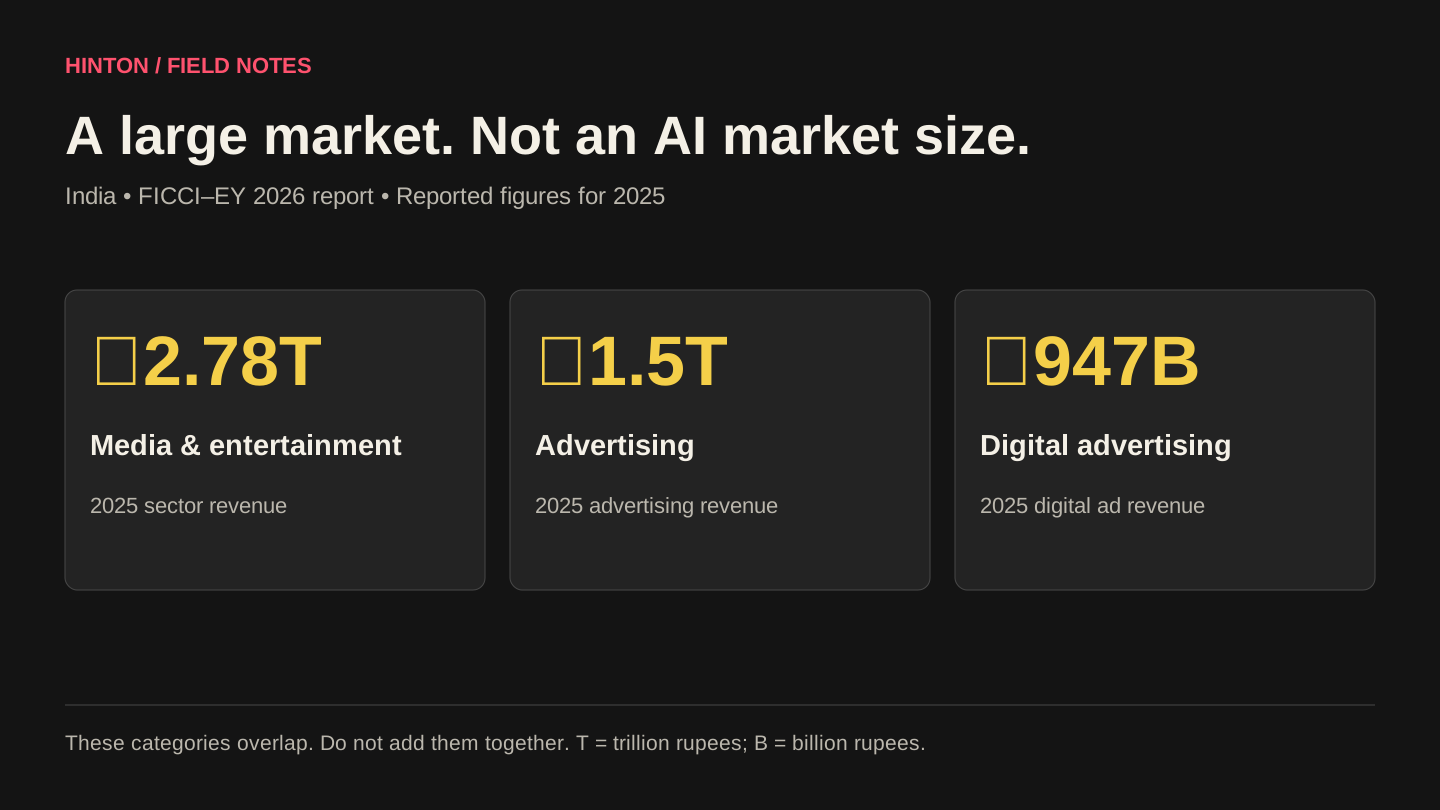
FICCI–EY reports India’s media and entertainment revenue at INR 2.78 trillion in 2025, up 9%. Its March 2026 release places advertising at about INR 1.5 trillion and digital advertising at INR 947 billion. These are overlapping market measures, not three amounts to add together. They describe the surrounding economy, not AI film production revenue.
The same release projects total media and entertainment revenue of INR 3.3 trillion by 2028. That is a forecast for the wider sector. It does not establish an AI-specific growth rate, production budget or available contract pipeline.
Why the opportunity feels different now
Consider a mid-sized brand with one strong product film. It may also need a portrait opening for social, a retailer version, a festival variation and regional-language adaptations. The challenge is not simply making another attractive clip. It is preserving the product, proposition and visual identity across all those versions.
AI-assisted development makes it possible to explore more treatments before a production commits. Whether that becomes a commercial advantage depends on approval speed, consistency and finishing. A faster first draft with weeks of repair is not a faster delivery. Studios that track the whole process will have a more useful sales story than studios comparing only generation time.
Build a market model from briefs, not headlines
A credible business model starts with a reachable group of customers. How many have a real need, authority to approve a budget and a repeat purchase pattern? Multiply realistic paid projects by an achievable average fee. Then subtract acquisition costs, creative development, generation, rejected versions, compositing, sound and project management.
For illustration only, 100 clients buying four projects a year at INR 2 lakh per project would produce INR 8 crore of gross annual revenue before costs. This is arithmetic, not a forecast or a statement about Hinton’s clients. Changing repeat frequency or realised fees can matter more than a model becoming cheaper. A national billion-dollar thesis would need defensible assumptions for adoption, pricing and demand; these sources do not supply them.
Four places to look for useful demand
Product storytelling, localisation, campaign development and narrative proof of concept offer different routes to value. They should not be sold as one generic “AI video” package. A product close-up demands fidelity. A multilingual campaign demands language and performance review. A film pitch demands coherent story and staging.
The right offer names the business outcome and the review process. An approved launch sequence, a set of localised cutdowns or a funding-ready scene study is easier to evaluate than a promise of unlimited content. Before scaling, test whether customers accept the work, return with another brief and can explain the value.
- Brands: a product benefit made clear in a short, approved sequence.
- Agencies: alternative visual treatments before committing the campaign.
- Regional campaigns: adaptations reviewed by fluent speakers and local creatives.
- Filmmakers: storyboards, previz and a focused scene proof of concept.
What could hold the market back
Clients need clarity on source assets, usage rights, approval responsibilities and what can be revised. Inconsistent faces or products, unclear licensing, weak sound and unreliable turnaround can erase the appeal of a cheap first render. Distribution also matters: a film that nobody sees cannot justify its production cost through visibility alone.
The strongest offer will usually combine new tools with familiar accountability. Define the scope, show a reference sequence, agree approval gates and specify the deliverables. Keep a realistic correction budget. Treat AI capability as one part of a production business, not a substitute for one.
Hinton’s place in the opportunity
Hinton can help a brand start with a bounded project: a product film, a brand story or a small campaign package with agreed adaptations. The first conversation should establish audience, product truth, creative ambition and how success will be measured.
India does not need another unqualified “billion-dollar AI” headline. It needs work that clients approve, audiences understand and teams can produce consistently. That is the opportunity worth building toward.
Research checked 27 September 2026. Product details can change. Workflow examples are editorial suggestions, not performance benchmarks or guaranteed results.