The question is bigger than “Will AI take my job?”
A junior artist learning a compositing tool is not just learning where the buttons live. They are learning what a convincing edge looks like, how light behaves and why a shot feels wrong. Automation can change how a task is executed without removing the need to recognise whether the result works.
That does not make the employment transition painless. Pricing pressure, changing staffing patterns and fewer routine tasks can affect real livelihoods. But declaring every traditional tool obsolete is poor career advice. The more useful question is which responsibilities an artist can own as the production process changes.
The slowdown is not a clean AI experiment
The FICCI–EY 2026 report estimates India’s combined animation, VFX and post-production revenue at INR 105 billion in 2025, compared with INR 103 billion in 2024. Within the rounded table, animation falls from INR 29 billion to INR 27 billion, while VFX rises from INR 47 billion to INR 48 billion. These are revenue estimates, not employment counts.
The figures do not establish how many jobs AI displaced or created. Nor does a segment’s weakness prove a single cause. Production cycles, commissioning decisions and client budgets also matter. Treat a claim about an AI-driven employment collapse as a claim requiring evidence, not a conclusion hidden inside a market chart.
Exposure is not the same as redundancy
The ILO’s 2025 research estimates that one in four workers globally is in an occupation with some generative-AI exposure. Its central distinction is that continued human input makes job transformation more likely than wholesale replacement for most occupations. This is a global task-based study, not an Indian VFX hiring forecast.
For a studio, this suggests examining tasks before deleting job titles. Preparing versions, organising assets and drafting scripts may be candidates for assistance. Diagnosing why a composite fails, protecting continuity and taking responsibility for final approval remain substantial work.
Build a portfolio that shows decisions
A reel of polished final images tells a reviewer what you selected. A concise breakdown shows what you can control. Include the brief, reference, intermediate state, difficult failure and correction. Explain which parts were generated, which were built conventionally and which you personally finished.
A useful exercise is a ten-second product scene with one deliberately hard element: a reflective object, a hand interaction or a moving shadow. Show how you solved it. Preserve editable files and organise the handoff. These are practical demonstrations of judgement and reliability, not claims that one exercise guarantees a job.
A learning path that does not throw away the foundations
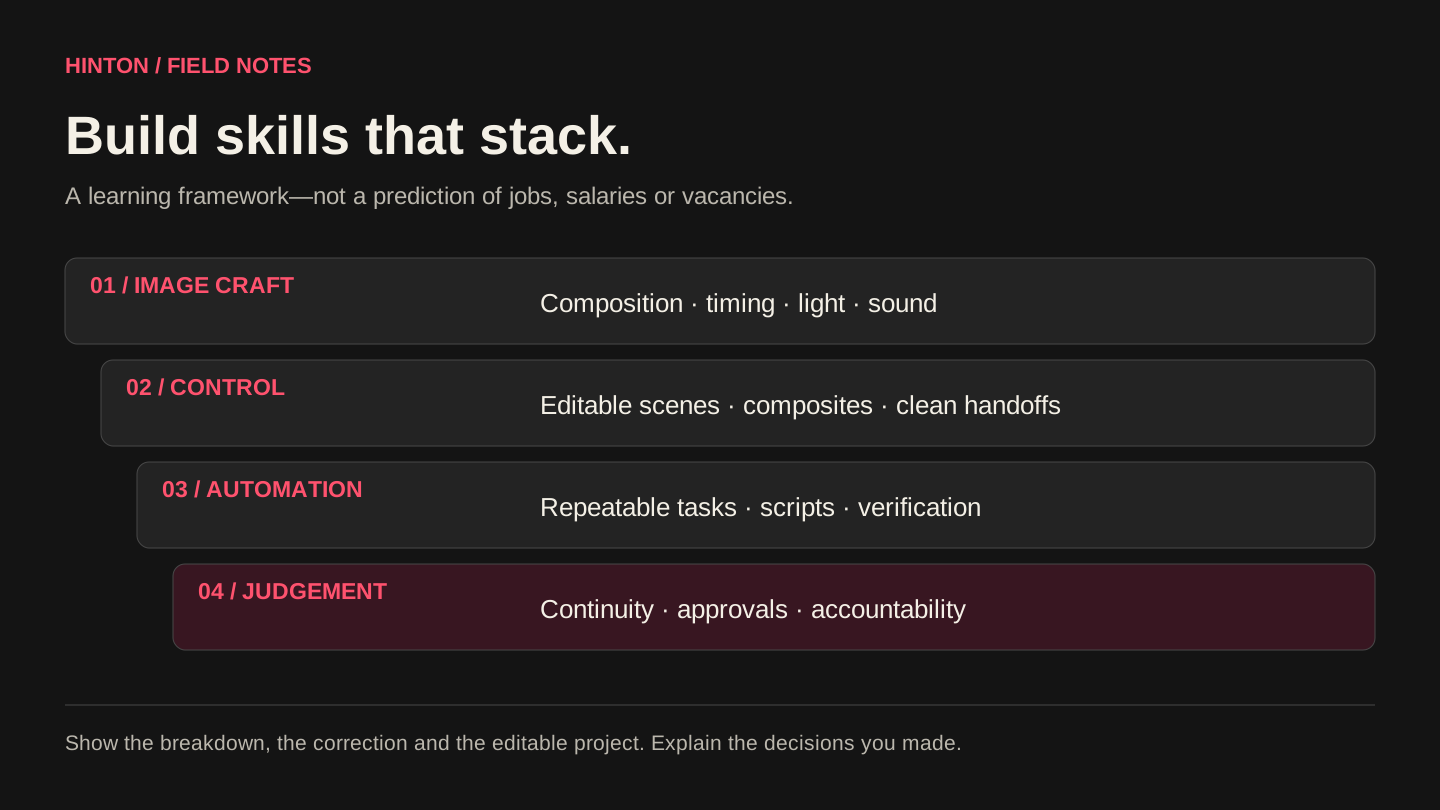
Start with composition, perspective, timing, colour and sound. Then build competence in one controllable production tool. Add a generative workflow only when you can assess its output. Finally, automate a repeated task that you understand well enough to test.
The order matters. If you cannot recognise a bad track or a broken matte, generating more options will not teach you which one is acceptable. If you can, a coding assistant may help you build a batch operation, validation report or versioning tool that makes the rest of your work easier.
- Week 1: recreate a simple shot and explain its light, staging and camera.
- Week 2: build an editable composite or 3D blockout with a clean handoff.
- Week 3: add one generated element and document every correction.
- Week 4: package a breakdown, review checklist and reproducible project.
Where new responsibilities may emerge
A team experimenting with generative footage needs people who can curate references, review continuity, integrate outputs and keep track of permissions and versions. A technically inclined artist may also help connect tools or create reliable batch workflows. These are plausible areas of responsibility, not a verified list of open vacancies or salary bands.
Likewise, a large media economy does not translate directly into a billion-dollar new job market. Revenue is not wages, and technology adoption is not guaranteed net employment growth. Candidates and employers deserve that distinction. Good workforce planning includes training, realistic supervision and clear ownership of final work.
What this means for a Hinton brief
For clients, the lesson is to choose a production partner for the quality of its decisions and final delivery. Ask how the team handles inaccurate products, broken continuity and late revisions. Ask to see relevant work and discuss a limited proof of concept.
Hinton’s VFX and CGI conversations begin with the shot’s requirements. Some elements benefit from generated exploration; others need controlled 3D or compositing. Keeping that choice open is a strength. This article is a skills perspective, not a recruitment announcement or a promise of available roles.
Research checked 27 September 2026. Product details can change. Workflow examples are editorial suggestions, not performance benchmarks or guaranteed results.