The hidden work between two good frames
A motion designer’s day contains more than animation. There are asset names to fix, subtitles to update, aspect ratios to adapt, review notes to reconcile and exports to check. None of that appears in the showreel, but it shapes what a project costs and how reliably it ships.
The interesting role for a coding agent is in this surrounding work. If it helps turn a repeatable instruction into an editable, testable operation, the designer can spend more attention on pacing, hierarchy and the idea. That is a practical hypothesis to test, not a promise that a model will finish a commercial unattended.
What Opus 5.5 and GPT-6 Astra actually are
Anthropic describes Opus 5.5’s strengths in coding and computer use. OpenAI describes GPT-6 Astra as a reasoning, coding and computer-use model; its model page lists text output and image input, with video unsupported as a direct modality. Tools can extend an agent’s workflow, but that does not make the language model itself a video renderer.
For motion work, the proposed connection is therefore indirect: help write scripts, structure scenes, analyse still frames or coordinate supported tools. Access, integrations and permissions determine what can actually run. A software benchmark is not a benchmark for animation taste, compositing quality or a studio’s delivery speed.
Start with a repeatable deliverable
Imagine a product launch requiring three aspect ratios and five language versions. The core animation is approved. The repeated work is replacing text, validating safe areas and producing a predictable file set. Define that structure before involving an agent.
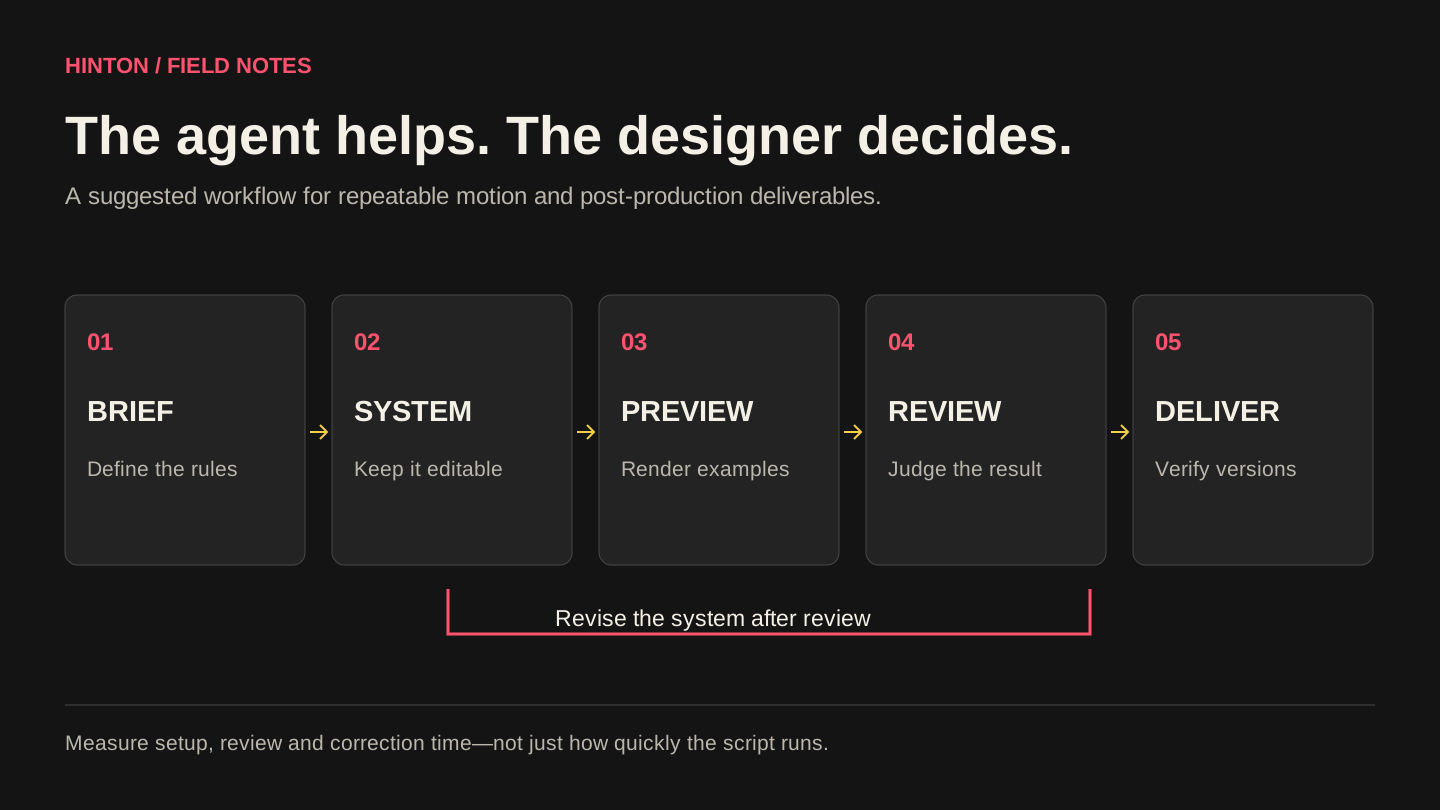
Separate fixed design decisions from variable content. Keep typography, colour, timing and logo placement in an editable template. Store the approved text and filenames in a simple manifest. Then ask the assistant to create the smallest automation that reads that manifest and reports missing inputs. This is easier to review than a large opaque script that both redesigns and exports the campaign.
Give the agent a contract, not a wish
“Make the animation better” invites uncontrolled changes. A useful request defines the input, protected decisions, output and checks. The assistant should explain what its script will touch and leave the original project intact. Test on a copy before running a batch.
Try this prompt · adapt to your project
Help automate versions of an approved motion project using the scripting interface of my installed application. First ask for the application version and inspect the available API documentation. Read a manifest of approved copy, language and output size. Preserve existing timing, fonts, colours and source assets. Create a separate version for each manifest row. Report missing assets and text overflow; do not silently replace fonts or shorten copy. Render a preview for review before final exports. Include an undo or recovery plan and a short validation checklist.
Keep animation judgement in the review loop
A technically valid render can still feel lifeless. Watch for the spacing of keyframes, the pause before a reveal, the weight of a transition and the relationship between picture and sound. A title fitting inside its box does not mean its line breaks are good. A portrait crop keeping the logo does not mean it preserves the story.
Review representative outputs before committing to the full batch. Choose the longest text, the narrowest format and the most complex scene. If those fail, fix the system rather than patching each export separately. This is where traditional design knowledge becomes especially valuable: it provides the criteria automation must satisfy.
Measure the whole job, including repairs
Run a bounded comparison on a real repeatable task. Record setup time, review time, correction time and accepted outputs for both the assisted and existing method. Count rejected renders and the cost of recovering from mistakes. Do not present a faster script execution as an equivalent reduction in project cost.
The useful outcome may be fewer manual mistakes, a more consistent handoff or more time for creative alternatives. It may also be that a familiar template is already the best tool. There is no requirement to add an agent to a task that is simple and reliable without one.
The business opportunity is an accountable service
A client buys a film or a campaign that works across its channels. They do not need to buy the internal complexity of the production pipeline. A studio can package the benefit as a coherent motion system, controlled localisation or a disciplined versioning service with review gates.
Hinton can discuss animated brand films, product sequences and campaign adaptations around that kind of brief. The strongest question is not whether AI replaces a named application. It is whether a human-directed workflow can deliver more useful work while keeping changes understandable and quality dependable.
Research checked 27 September 2026. Product details can change. Workflow examples are editorial suggestions, not performance benchmarks or guaranteed results.